Also read: Looking to make your mobile app truly stand out in a crowded market? Explore our guide to the top 25 must-have mobile app features that can improve user experience, boost engagement, and set your app apart from the competition.
Top Technologies for Creating Mobile Apps You Should Know


15 December, 2025
Mobile applications are an indispensable core component of any successful strategy. With over seven billion active smartphone users globally, the battle for consumer engagement is waged almost entirely on the small screens.
Today’s apps serve as powerful platforms for sharing information, collaborating with partners, and engaging with customers, no matter where they are. From simple productivity tools like calendars and email to advanced AI-driven eCommerce and health apps, mobile technology has evolved far beyond its initial capabilities.
This evolution has fundamentally shaped user behaviour. Research from eMarketer shows that U.S. adults spend over 88% of their mobile time on apps, with many preferring in-app experiences over mobile browsers. This presents a huge opportunity for businesses to create user-friendly apps that people will want to use.
But, capitalizing on this opportunity requires the right technical foundation. The choice of development languages and platforms is critical, directly impacting an app’s success.
In this guide, we discuss the top technologies you should know to build successful mobile apps that attract and retain users.
Top Programming Languages for Building Mobile Apps Today
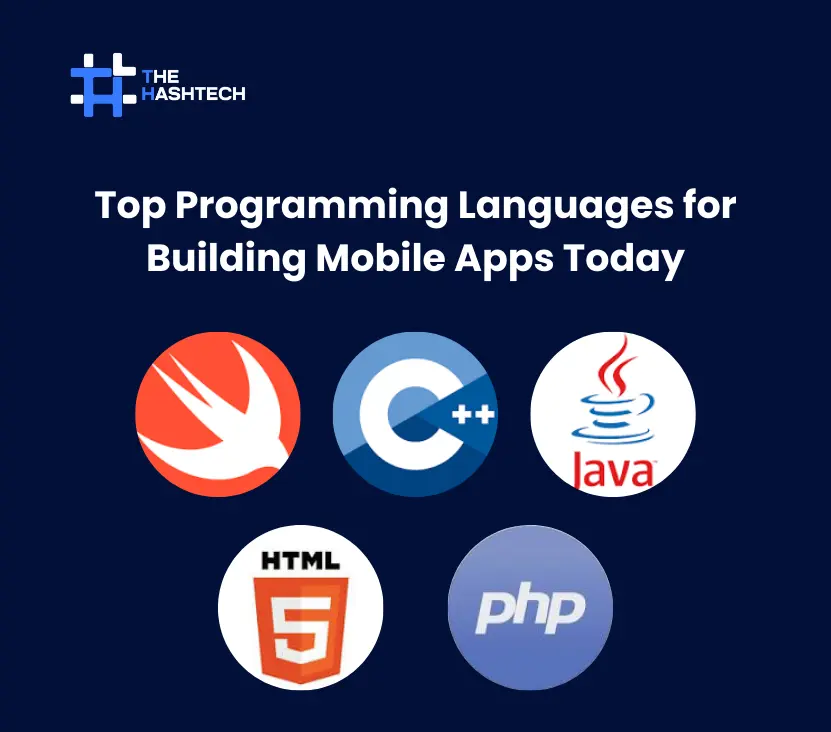
Here are five popular programming languages used for developing mobile apps today:
1. Swift
Swift is a top choice for iOS app development, especially since iOS holds a large share of the mobile OS market in the U.S. Swift is an open-source, game-changing language designed for safety, performance, and ease of use. It’s often considered a successor to Objective-C and C. Swift is interactive, easy to read, and helps developers create apps quickly and effectively.
Key Features of Swift:
- Optimized performance for many types of applications.
- Built-in error handling that reduces mistakes and makes code more readable.
- Clean syntax that makes it easier to maintain and read code.
- Memory management keeps usage low, avoiding unnecessary system load.
- Interoperability with Objective-C, allowing you to work with older files in the same project.
2. C++
C++ is one of the most important languages used today, especially for creating software like apps, games, and systems. It helps you build high-performance, complex apps that work on different devices. With C++, you can write code once and run it on multiple platforms such as Android, iOS, and Windows without compromising the app’s performance or security. C++ is a flexible language that allows you to develop across various platforms while also promoting efficient and reusable code.
Key Features of C++
- Complete control over system resources: C++ lets you manage memory and system functions directly, which is great for performance.
- Cross-platform development: You can build applications that run on multiple platforms like mobile phones and desktop computers.
- Mobile app support: C++ allows you to develop apps for different devices and use cases.
- AI support: You can create software solutions that use Artificial Intelligence.
- Time-saving libraries: C++ has built-in libraries that save developers time and effort.
- Early error detection: The compiler helps find errors during development, saving time fixing issues.
3. Java
Java is one of the most reliable and widely used programming languages. It is a key language for Android app development and works across many platforms. Java lets developers write code once and run it on different devices, saving time and effort. This flexibility allows Java to be used in a wide range of applications, from mobile apps to web apps. Java is easy to learn, and there are many free resources and libraries available to help developers build great software.
Key Features of Java
- Great for building secure, powerful apps: Java is widely used for creating secure client-server applications.
- Automatic memory management: Java automatically manages memory to avoid memory issues.
- Works on any machine: Java code runs on the Java Virtual Machine (JVM), no matter what hardware or operating system you’re using.
- Faster program execution: Java uses Just-in-Time (JIT) compilation to speed up how programs run.
- Helpful libraries: Java provides built-in libraries to handle tasks like graphics, threading, and networking.
- Cross-platform and reusable code: Java is known for making code portable and easy to reuse across different systems and devices.
4. HTML5
HTML5 is the latest version of HTML, the language used to structure and display content on the web. Developers creating cross-platform mobile apps can benefit from HTML5 as it supports multi-platform functionality and delivers a great user experience. HTML5 makes it easier to create apps that work on different browsers and devices, and it supports responsive design. By using HTML5, developers can create dynamic, interactive mobile websites with greater efficiency and performance.
Key Features of HTML5
- Built-in video and audio support: HTML5 allows developers to easily add audio and video to websites without needing a separate player.
- Scalable graphics: HTML5 allows for better graphics with vector images, making them easier to load and transfer on the web.
- Interactive and animated content: HTML5 supports tags and media elements to create more interactive experiences and animations.
- Faster loading: HTML5 apps load quickly with the help of local storage, web cache, and database features.
- Easier to update and maintain: The simpler syntax of HTML5 makes it easier for developers to keep up with web standards and changes.
Want to build a cutting-edge mobile app?
Contact our experts today to discover the top technologies for creating a smart, scalable, and cost-effective app.
5. PHP
PHP is a popular programming language used for building web and mobile apps that need to connect to databases. It is free, open-source, and often used as an alternative to Microsoft’s ASP. Initially created for developing websites, PHP is also a great choice for building mobile apps, particularly those that need a strong backend. Popular frameworks like Laravel, CodeIgniter, and Symfony make PHP even more efficient for mobile app development by simplifying processes like caching and authentication.
Key Features of PHP
- Supports many types of databases: PHP works well with a wide range of databases, making it ideal for handling data forms.
- Works on different platforms: PHP is compatible with various browsers and servers and supports many protocols like HTTP, IMAP, and more.
- Easy to optimize: PHP is a well-structured language with many built-in functions, making it easy to improve and optimize your code.
- Manages sessions efficiently: PHP ensures better memory use by managing sessions well, reducing unnecessary memory allocation.
- Real-time monitoring and error handling: PHP provides tools to track access in real time and handle errors smoothly.
- Security features: PHP has predefined functions for encrypting data, ensuring a safe and secure environment for users.
Top Tools to Help You Build Your Own Mobile App
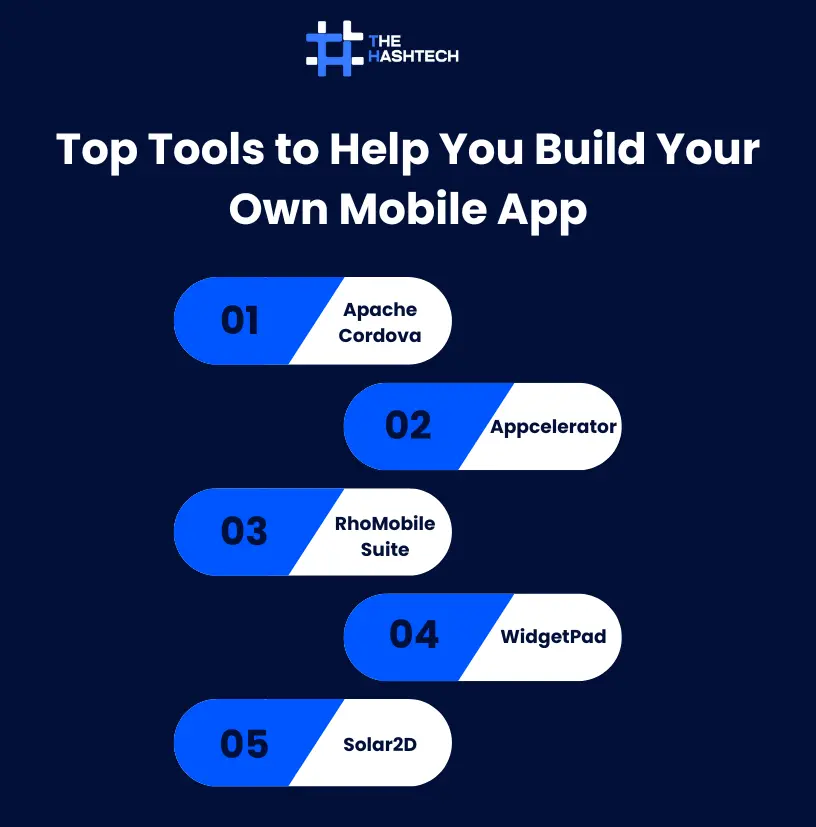
These tools are great for creating mobile apps from scratch. They also allow you to build apps that can work on multiple platforms, helping you reach a larger audience.
1. Apache Cordova
Apache Cordova (formerly known as PhoneGap) is a tool for building hybrid mobile apps using web technologies like HTML, CSS, and JavaScript. It allows developers to create apps that work on different mobile platforms without rewriting the code for each one. Apps built with Cordova use special “wrappers” to access the features of each device. It also includes APIs that let apps use data from the device, like its sensor or network status. Apache Cordova allows developers to mix native and web-based code to create apps that are not fully native or web-based, but a mix of both.
2. Appcelerator
Appcelerator is an open-source tool for building mobile apps that work on multiple platforms, such as Android, iOS, and Windows, using a single codebase. In 2016, it was acquired by Axway, a company that helps businesses manage their data. Appcelerator’s framework is cloud-based, so developers can use it from anywhere. It comes with pre-built UI components and an app framework called “Alloy” to organize the app’s user interface, business logic, and data models. Appcelerator helps developers succeed by offering real-time mobile analytics, a scalable cloud service, and tools for building APIs and running apps.
3. RhoMobile Suite
RhoMobile Suite (previously known as Rhodes Framework) is an open-source toolset for building cross-platform mobile apps. It uses popular web technologies like HTML5, JavaScript, CSS3, and Ruby to create native apps. With RhoMobile, developers can write an app once and run it on multiple platforms, including iOS, Android, and Windows. The suite includes several tools like RhoStudio, RhoConnect, RhoElements, and RhoGallery. Tau Technologies, the company behind RhoMobile, claims that using this framework can cut both the cost and development time for mobile apps by up to three times.
4. WidgetPad
WidgetPad is an open-source tool that provides a great environment for building cross-platform mobile apps for iOS, Android, and WebOS. It uses common web technologies like CSS3, JavaScript, and HTML5 to ensure a secure and open development process. The framework offers many features for developers, such as source code editing, version control, debugging, project management, and app distribution. WidgetPad helps simplify the creation of mobile apps, allowing developers to quickly add common features like maps, social media feeds, forms, video players, and more with just a few clicks.
5. Solar2D
Solar2D (previously known as Corona SDK) is a free, open-source tool for building cross-platform apps. It is currently maintained by Vlad Shcherban and developed by Corona Labs. Developers use Solar2D to create 2D mobile apps for platforms like Kindle, Android, and iOS, as well as connected TV apps for Android TV, Apple TV, and Fire TV using just one codebase. Solar2D also helps build desktop apps for Linux, macOS, and Windows. The framework offers plugins for essential features like in-app advertising, analytics, and media. Solar2D is based on Lua, a lightweight, fast, and powerful scripting language. The Solar2D Native feature lets developers extend the framework’s functionality by calling external libraries or APIs.
Types of Mobile App Development
Before deciding on the right technology for mobile app development, it’s important to first understand what type of app you’re building. There are 3 main types of mobile apps that are key to this discussion, and we’ll go over them briefly below:
1. Native Apps
Native mobile app frameworks are designed for building apps specific to one platform, like iOS, Android, or Windows. For example, Java and Kotlin are used to create Android apps, while Objective-C and Swift are used for iOS apps. Native apps can take full advantage of the device’s hardware and software, offering better performance and more efficient results.
2. Cross-Platform Apps
Cross-platform apps are software that can work seamlessly on both Android and iOS with the same code. This means that the app will run smoothly on either operating system. The main advantage is that it saves time and resources, especially for teams with limited budgets, as they only need to create one version of the code.
However, there are some downsides. The process of developing mobile applications with a cross-platform approach can sometimes result in quality that’s not as high as native apps. Also, cross-platform apps typically need more service support for things like version updates, as they have to stay compatible across both platforms.
3. Hybrid Apps
Hybrid frameworks mix the features of both native and cross-platform frameworks. These frameworks provide plugins that allow developers to use standard web technologies like HTML5, CSS3, and JavaScript to create native apps. For example, Apache Cordova offers plugins that connect to native device features like the camera, GPS, and notifications. Similarly, Ionic’s Capacitor plugin helps developers create apps that work natively on both iOS and Android devices.
Top Mobile App Development Frameworks to Explore
Discover the top mobile app development frameworks that developers should consider using to build award-winning apps.
1. Flutter
Flutter is an open-source development tool created by Google. It allows developers to build apps for both Android and iOS using a single codebase. With Flutter, you can easily build, test, and launch mobile apps that work on all devices (mobile, desktop, web).
It uses the Dart programming language, which helps create high-performing apps by providing fast analysis and easy fixes. Flutter doesn’t depend on web browsers or device-specific widgets; instead, it uses its own high-performance engine to customize widgets for a smooth experience.
2. React Native
React Native is a popular open-source framework for building native mobile apps using JavaScript. It supports both iOS and Android app development, making it one of the most preferred technologies today. With React Native, developers can create mobile apps using the same design principles as React, and the apps built are truly native.
This means the apps will function just like those built with Objective-C, Java, or Swift. React Native can be used to improve your existing iOS and Android apps or to create entirely new apps from scratch. The framework allows you to share code between platforms, making it easier to develop apps for multiple systems from a single codebase.
3. Ionic
Ionic is a modern, open-source tool for building apps that work on both iOS and Android. It uses web technologies like HTML5, CSS3, and JavaScript to create apps for multiple platforms from a single codebase. Ionic makes it easy to design and build mobile apps, and it works with iOS’s UIWebView and Android’s WebView.
Built on top of AngularJS and Apache Cordova, Ionic provides developers with the tools to quickly create, grow, and manage cross-platform mobile apps. It also offers built-in tools for testing and deploying apps, helping developers publish apps directly to the Google Play and Apple App Stores. Ionic’s cloud security and mobile solutions keep sensitive data safe.
4. Xamarin
Xamarin is a free, open-source platform for building apps for both iOS and Android using .NET and C#. It allows developers to share code across platforms and access native features, making it easier and cheaper to create apps. Xamarin lets you build apps for Android, iOS, and Windows from a single shared codebase.
It provides access to all the features of the platform and device, including specific capabilities for each one. Xamarin also works seamlessly with Azure Cloud, helping you build scalable and efficient mobile apps with back-end services like storage and databases.
5. NativeScript
NativeScript is an open-source framework, originally developed by Progress, for building mobile apps for both iOS and Android. It allows developers to use JavaScript or other languages like TypeScript that convert to JavaScript. NativeScript offers powerful features like integration with Native APIs, Angular, and Vue.js.
It also allows developers to reuse third-party libraries from Maven, npm, and CocoaPods without extra wrappers. The framework supports JavaScript, Angular, and TypeScript, making it easy to reuse components. NativeScript gives full access to iOS and Android APIs, enabling developers to build feature-rich apps.
6. Felgo
Felgo (formerly known as V-Play Engine) is a popular framework for building cross-platform mobile apps. It allows you to create flexible and modern apps from a single codebase for platforms like Android, iOS, Desktop, Web, and Embedded systems. Felgo uses the Qt framework, which makes it easier to develop high-quality apps for industries such as telecommunications, entertainment, and automotive.
Felgo claims that developers can save up to 90% of the code by reusing components across platforms. The framework also provides tools like QML Hot Reload, Felgo Cloud Builds CI/CD, and Felgo Cloud IDE to help developers build, distribute, and publish apps more quickly.
7. Mobile Angular UI
Mobile Angular UI is an open-source framework that combines the best features of AngularJS and Bootstrap. It adds the mobile-specific components missing from Bootstrap, like navbars, sidebars, modals, and switches, to create high-quality, mobile-friendly user interfaces.
Since it uses AngularJS and Bootstrap, it’s easy for developers to learn and get started. Mobile Angular UI helps businesses create HTML5 hybrid mobile and desktop apps with less effort. You can quickly turn an existing web app into a mobile app by adding a CSS file, which will make the app responsive and usable on any device.
Ready to build your app with top programming languages?
Contact our experts to discover the best languages for building fast, reliable mobile apps.
Top Trends in Mobile App Development
Mobile app development will become faster and smarter in the coming years. Here are some key trends that will shape the future of mobile development in this decade:
1. Artificial Intelligence
Using Artificial Intelligence (AI) and Machine Learning (ML) in mobile app development can reduce the mistakes often made by human programmers. For example, McDonald’s uses AI to personalize drive-thru menus based on customer preferences. In telemedicine apps, AI helps reduce the time spent on administrative tasks.
AI is also used in automated warehouses, smart logistics apps, chatbots, voice assistants, and voice recognition apps. It helps with predictive analytics for e-commerce, as well as security apps using facial recognition to prevent fraud. Integrating AI in mobile apps will boost user engagement and save businesses money.
2. Mobile Commerce
According to Statista, mobile e-commerce sales in the United States are expected to exceed $430 billion by the end of 2025. More people are using mobile apps for shopping, paying bills, booking tickets, and handling daily financial tasks.
By 2025, about one-third of U.S. consumers were buying products online every week using their mobile phones. Younger generations, especially Gen Z and millennials, prefer contactless payments through apps like Apple Pay and Google Pay. Embracing mobile commerce is crucial for businesses to stay competitive and replicate the success of major e-commerce companies like Amazon.
3. AR and VR Apps
The use of Augmented Reality (AR) in mobile apps continues to grow. By the end of 2024, there will be 1.73 billion mobile AR users. AR is becoming popular in many industries, including retail, education, healthcare, and manufacturing, as companies use it to create powerful mobile experiences that give them a competitive advantage.
Virtual Reality (VR) is also changing how mobile apps are developed. VR, which connects with phones, apps, and wearables, improves the user experience and helps people interact with fully functional mobile apps. A study by Design News found that 29% of manufacturers saw an increase in productivity and efficiency after adding AR/VR technology to their operations.
4. 5G Technology
5G, the fifth generation of mobile network technology, is the latest global standard for wireless communication. It connects machines, devices, and objects to provide users with a fast and reliable experience. 5G offers higher data speeds, better reliability, more network capacity, and ultra-low latency. This will change how mobile apps are developed and used.
According to GSMA, by 2025, more than 63% of global mobile devices and connections will be 5G-enabled. 5G will dramatically speed up mobile apps, allowing developers to add new features without affecting app performance. It is expected to improve network efficiency and boost traffic capacity by reducing latency by up to 10%.
5. Low-Code Apps
The growing trend of moving web and mobile apps to containerization and microservices is making low-code apps more popular. Platforms like Mendix, Appian, Microsoft Power Apps, and Zoho Creator offer easy-to-use environments for building apps. These platforms include pre-built connectors, smart services, drag-and-drop tools, and components to speed up app creation.
According to Hostinger, over 75% of the apps developed in 2026 were built using low-code platforms. These platforms help businesses get apps to market faster, solve the shortage of skilled developers, and reduce development complexity. Low-code app development helps businesses quickly launch apps, easily adapt to market changes, lower hiring costs, and maintain a consistent user experience.
6. Accelerated Mobile Pages (AMP)
The speed at which your mobile app loads directly affects your business. For instance, an online store making $100,000 daily can lose up to $2.5 million every year if there’s even a slight delay in loading time. Google’s AMP (Accelerated Mobile Pages) is a crucial tool that influences how your mobile site ranks in search results. Websites with AMP optimization will load faster, perform better, and have a higher chance of turning visitors into customers.
How Our Mobile App Development Services Can Help You
Investing in custom mobile app development is the best way to align your business with the needs of your target audience. If your business already has an active mobile app, your growth strategy should focus on enhancing it with the latest technologies to offer even more value to your customers.
Our team specializes in mobile app development, and we can guide your app to success from start to finish. With our expert knowledge, we’ll help you stay ahead of competitors, lower your costs, boost your brand’s visibility, and engage customers like never before. Get in touch with us to learn more!
FAQs on Mobile App Development Technologies
What are the main technologies used in mobile app development?
Mobile app development involves various technologies that cater to different needs. Native app development relies on platform-specific languages, such as Swift and Objective-C for iOS, and Kotlin and Java for Android. These technologies allow developers to build apps that are optimized for each platform, providing superior performance and a smoother user experience.
On the other hand, cross-platform development technologies like React Native, Flutter, and Xamarin enable developers to create apps that can run on both iOS and Android with a single codebase, thus saving time and resources.
Additionally, hybrid apps that use web technologies like HTML, CSS, and JavaScript are packaged into native apps using tools like Ionic and PhoneGap. While hybrid apps are cost-effective, they often face performance trade-offs compared to native solutions.
What’s the difference between native and hybrid app development?
The main distinction between native and hybrid app development lies in how the app is built and performs.
- Native apps are developed specifically for one platform (iOS or Android) using the respective native programming languages. These apps offer the best performance, seamless user experiences, and full access to device features like cameras, GPS, and sensors. However, they require separate codebases for each platform, which can increase both development time and costs.
- Hybrid apps are developed using web technologies (such as JavaScript, HTML, and CSS) and are then wrapped in a native container to run across multiple platforms. While hybrid apps are faster and more cost-effective to develop and maintain, they may not offer the same level of performance and can sometimes struggle with accessing device-specific functionalities.
Which is better: Android or iOS development?
The choice between Android and iOS development largely depends on your target audience and business objectives.
- Android has a larger global market share, especially in emerging markets, and is suitable for businesses targeting a wide range of devices. However, developing for Android can be more complex due to the diverse array of devices, operating system versions, and screen sizes.
- iOS, on the other hand, typically offers a more uniform device experience, making development easier and faster. While iOS has a smaller market share globally, its users tend to be more concentrated in wealthier regions like the United States and Western Europe. iOS also has higher customer spending on apps, which may be beneficial for businesses focusing on paid apps or in-app purchases.
How do I choose the right technology for my app?
The selection of the right mobile app development technology should depend on a variety of factors including project complexity, target audience, and available resources. If your app requires high performance or needs to integrate deeply with device features, native development might be the best option, as it offers superior speed and access to platform-specific features.
For simpler apps that need to function across both iOS and Android, cross-platform development frameworks like React Native or Flutter are more cost-effective and faster to build. It’s also important to consider the long-term maintenance of the app, as native apps require separate codebases for iOS and Android, while cross-platform apps can be updated simultaneously.
Finally, the budget and timeline also play a significant role in your decision. Consulting with experienced developers can help you understand the trade-offs and make the best decision based on your business goals.
Additionally, planning an app idea? Check out our detailed breakdown of app development costs in 2026 to better understand pricing, features, and timelines.
Which programming languages are used for mobile app development?
For developing Android mobile apps, the most commonly used programming languages are Java, Kotlin, Python, R, C++, HTML5, and C#. On the other hand, iOS mobile apps are typically built using languages like Swift, Objective-C, C#, and HTML5. These programming languages power the development of mobile apps on their respective platforms and are chosen based on the app’s specific needs and performance requirements.